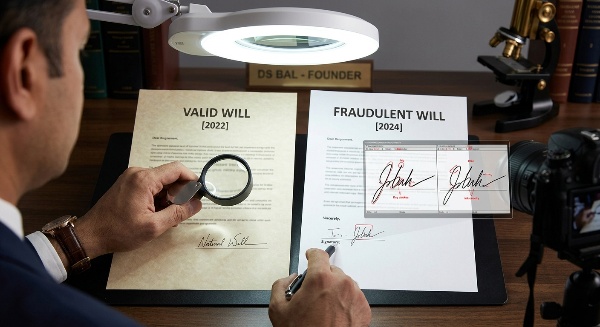
The Wills Bill 2025, set for major implementation phases in 2026, introduces “Electronic Wills” and replaces the 150-year-old Banks v Goodfellow capacity test with the Mental Capacity Act 2005 standard. While these updates aim to modernize the law, they create significant new risks for fraud and undue influence. The shift toward digital signatures and “dispensing powers”, which allow courts to validate informal documents like voice notes or emails, means that “The Skeptic” must now be more vigilant than ever in auditing the digital trail of a testator’s final days.

The Digital Wild West: Electronic Wills in 2026
For nearly two centuries, the “Wet Ink” signature was the ultimate gatekeeper of validity. The Wills Bill 2025 has dismantled this barrier. In 2026, we are entering an era where a Will can be created, signed, and witnessed entirely on a tablet or smartphone.
As a Validity Specialist, I view this as a double-edged sword. While it assists those with mobility issues, it removes the “physical safeguards” of a traditional signing ceremony. In a digital setting, how do we know who was actually in the room? Was there someone off-camera directing the testator’s hand? The “Digital Audit Trail” is now our primary tool. We no longer just look at the paper; we analyze metadata, IP addresses, and video timestamps to ensure the testator was acting of their own free will.
The Death of Banks v Goodfellow: A New Capacity Standard
Since 1870, the Banks v Goodfellow test has been the gold standard for testamentary capacity. It focused specifically on the “moral claims” a testator should consider. The 2026 transition to the Mental Capacity Act (MCA) 2005 standard changes the game for challengers.
The MCA 2005 starts with a presumption of capacity. This shifts the initial burden onto “The Skeptic.” You must now prove an “impairment of the mind or brain” before the court will even look at whether the testator understood their Will. For cases involving “Social Masking”, where a person with dementia appears lucent but lacks executive function, this new statutory test requires much more rigorous medical evidence than the old common law test.
Dispensing Powers: When a Text Message Becomes a Will
Perhaps the most controversial update in 2026 is the court’s new “Dispensing Power.” Under the Wills Bill 2025, a judge can now declare a document valid even if it fails all traditional formalities, provided there is “clear and genuine” evidence of intent.
This means that a draft email, a saved voice note, or even a series of WhatsApp messages could potentially be admitted to probate as a valid Will. For a Validity Specialist, this is a nightmare for fraud prevention. We are already seeing “predatory” influencers “discovering” unsent digital drafts that conveniently leave the estate to them. Challenging these requires a new type of forensic investigation, one that merges legal expertise with digital forensics.
The “Predatory Marriage” Shield: Section 18 Reform
A long-awaited victory in 2026 is the reform of Section 18 of the Wills Act 1837. Previously, marriage automatically revoked a Will, a loophole used by “predatory” individuals to marry vulnerable seniors and inherit their entire estate via intestacy.
Under the 2025 Bill, marriage no longer automatically revokes an existing Will. For “The Skeptic” fighting to protect a parent’s legacy, this is a powerful new shield. It prevents a “deathbed marriage” from wiping out decades of careful estate planning. However, it also means that older Wills remain valid longer than expected, which can lead to disputes if a testator actually wanted to change their Will after marriage but forgot to do so.
Shifting the Burden: The New Undue Influence Test
In the past, proving undue influence was notoriously difficult; you had to prove “coercion” (that the testator was forced). The 2026 reforms introduce a statutory presumption of undue influence in certain relationships.
If a beneficiary was in a position of trust (like a live-in carer) and the Will “calls for an explanation” (e.g., leaving everything to the carer and nothing to the children), the burden of proof now shifts. The beneficiary must prove they didn’t exert pressure. This is a massive tactical advantage for challengers, turning the “closed-door” nature of elder abuse into a legal liability for the influencer.
The 2026 Security Mandate
Electronic Wills are only valid if they use a Government-Approved Central Storage System. If someone presents you with a “Digital Will” saved only on a personal laptop or a generic cloud drive, it is likely invalid under the strict security standards of the 2025 Bill. Always verify the storage source.
Modernization Requires Greater Mentorship
The Wills Bill 2025 has brought the 19th-century law into the 21st century, but it has traded “procedural certainty” for “intentional flexibility.” For “The Skeptic,” this means the fight has moved from the signing room to the server room. To protect an estate in 2026, you must understand both the new mental capacity standards and the high-tech ways that signatures can now be forged or coerced.
FAQs
Q1: Does the new law apply to Wills made before 2026?
Generally, no. The new formalities for Electronic Wills and the “Dispensing Power” usually apply only to documents created after the law’s commencement date. However, the new Mental Capacity Act standard may be applied by courts to older Wills if the capacity is being litigated in 2026.
Q2: Can a video recording be a valid Will now?
Under the “Dispensing Power,” a court could potentially validate a video recording if it is convinced it represents the testator’s final, settled intentions. However, this is intended as a “last resort” for emergency situations (like a sudden hospital admission) and is not a replacement for a formal Will.
Q3: How do I stop an “Electronic Will” from being probated?
The process remains the same: lodge a Caveat immediately. This stops the digital document from being recognized by the Probate Registry, giving you time to demand a “Digital Audit Trail” and challenge the authenticity of the electronic signature.
Let’s Do This Together
Contesting a will could become an overwhelming experience if not accompanied by expert guidance and support. Our mission is to provide you with all the needed information, support, and authority to get through this journey, with only one goal in mind: Fairness.
To our team, this process is not about winning; it’s about claiming what was yours from the beginning.
Don’t forget to check our complete guide on the lack of mental capacity here.
Get your free, no-obligation case assessment. Call 08002980029 or visit contestawilltoday.com