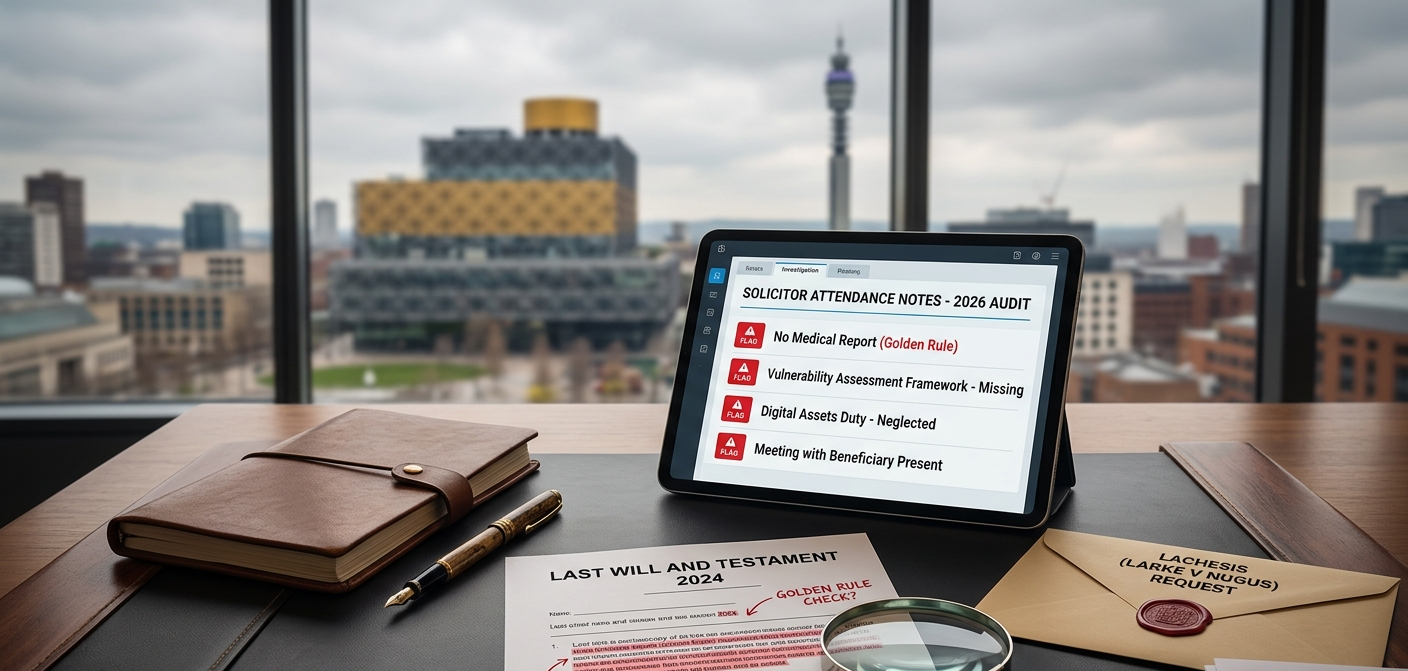
Is a Solicitor’s Failure to Follow the Golden Rule Grounds for Contesting a Will in 2026?

contact

For a free initial conversation call

0800 29 800 29

The Golden Rule in 2026 remains the judicial benchmark for determining if a solicitor took adequate steps to verify a testator’s capacity. If a legal professional failed to secure a medical report for an elderly or ill client, it creates a “rebuttable presumption” of professional negligence. This failure is often the strongest weapon in a Will contest, as it shifts the evidentiary burden and can make the solicitor’s firm liable for the costs of the dispute.

Read our complete guide on contesting a will for lack of capacity.
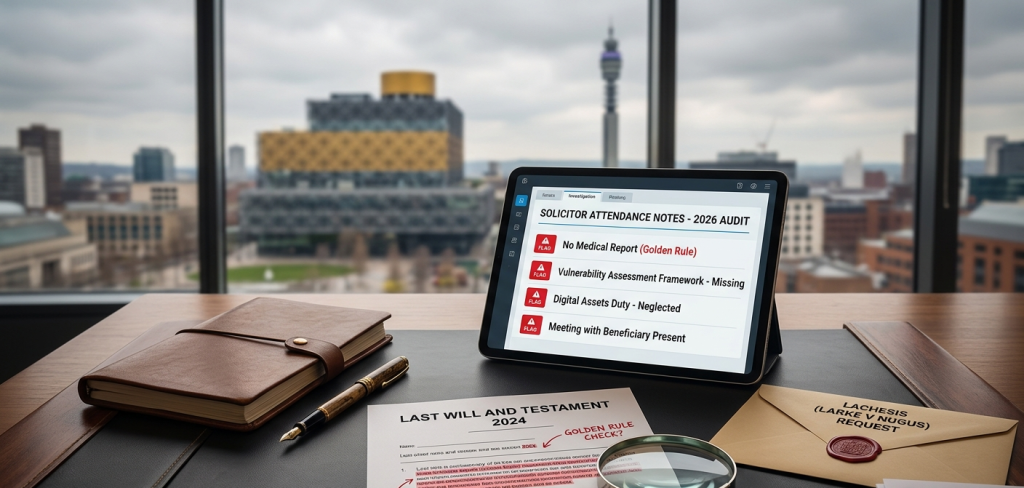
solicitor-negligence-the-golden-rule-birmingham-dsbal-2026.png

The “Golden Rule” is not a statutory law, but a long-standing judicial guideline reaffirmed in 2026 as a critical safeguard against inheritance disputes. It dictates that when a solicitor is instructed to draft a Will for a testator who is elderly or has a history of serious illness, they should ideally have the execution witnessed or approved by a medical practitioner.

In the high-stakes environment of 2026 probate, this rule serves as the ultimate “insurance policy” for a Will’s validity. If a solicitor bypasses this step, they leave the estate vulnerable to claims that the testator lacked the mental capacity to understand the consequences of their decisions.

When contesting a Will, proving “Incapacity” can be medically difficult after the testator has passed. However, proving Professional Negligence against the drafting solicitor is often a more direct path to victory. If the solicitor failed to follow the SRA (Solicitors Regulation Authority) 2026 standards for capacity checking, their “Attendance Notes” become the primary evidence against the Will. A negligent solicitor who didn’t ask probing questions or failed to identify “red flags” essentially hands the challenger a roadmap to voiding the document.

In 2026, the High Court is increasingly strict regarding the “Burden of Proof.” Ordinarily, the person contesting the Will must prove the testator was unfit. However, if it is proven that the solicitor failed the “Golden Rule,” the burden often shifts back to the executors to prove the testator was fit. This technical shift is a massive strategic advantage for our clients at Contest A Will Today, as it forces the opposing side to produce medical evidence that may not exist.

Under the Lachesis (Larke v Nugus) request protocol, we can demand the drafting solicitor’s entire file. In 2026, we look for “Thin Notes.” If a solicitor simply wrote “Testator seemed fine,” without documenting a deep-dive into the assets or moral claims, they have likely been negligent.

  • Red Flag: No mention of why a child was disinherited.
  • Red Flag: No record of the testator’s recent medical history or medications.
  • Red Flag: Meeting the testator in the presence of a beneficiary.

A common 2026 battleground is the “Expertise Gap.” Many solicitors claim they can “judge capacity” themselves, but the High Court disagrees. Following the Re: Thompson [2025] ruling, the courts have stated that a solicitor’s “gut feeling” is no substitute for a formal MoCA (Montreal Cognitive Assessment) or a psychiatric report. If a solicitor played doctor and got it wrong, the Will is almost certainly heading for a successful challenge.

One of the most powerful aspects of using negligence as a weapon is the “Cost Recovery” factor. If a Will is voided because a solicitor was negligent, the claimant can often sue the solicitor’s firm for the legal costs incurred during the dispute. This significantly lowers the financial risk for our clients, as the solicitor’s Professional Indemnity Insurance becomes the “pot” that covers the litigation fees.

The SRA updated its “Code of Conduct” in late 2025 to include stricter definitions of “Vulnerability.” Solicitors are now required to use a Vulnerability Assessment Framework before taking instructions.

  • Mandatory Checklist: Identifying signs of “Sundowning.”
  • Mandatory Checklist: Checking for digital asset competency.
  • Mandatory Checklist: Verifying the testator’s independence from their “new friends.” Failure to use this framework is a direct admission of professional negligence in 2026.

In 2026, the Lachesis Protocol (formerly Larke v Nugus) is the first step in any negligence-based Will contest. It forces the solicitor to answer a series of pointed questions about how they verified the testator’s mind. If the solicitor is slow to respond or provides vague answers, the court can draw an “adverse inference”—essentially assuming they have something to hide.

With the Property (Digital Assets etc) Act 2025, solicitors now have a duty to ensure the testator understands their digital estate. If a solicitor drafts a Will but fails to ask about crypto-keys, NFTs, or digital intellectual property, they may be negligent. A testator who “forgot” they had £2M in Bitcoin likely didn’t have the “extent of their property” in mind, and a solicitor who didn’t check this failed the Banks v Goodfellow test.

A “Deathbed Will” is the ultimate test of the Golden Rule. In 2026, if a solicitor drafts a Will in a hospital or hospice without a doctor’s sign-off, the High Court views it with extreme suspicion. The “Heightened Duty of Care” means the solicitor must take double the usual precautions. If they didn’t, the Will is highly susceptible to a “Lack of Knowledge and Approval” claim.

At Contest A Will Today, we don’t just sue the estate; we look at the conduct of the professionals involved. By identifying professional negligence early, we can often force a settlement before a case even reaches the High Court. If a solicitor knows their file is weak and their insurance is at risk, they are much more likely to advise the executors to settle the claim in your favor.

In late 2025, Arthur, a 92-year-old retired engineer in Birmingham with a diagnosed history of “mild cognitive impairment,” instructed a high-street solicitor to draft a new Will. This new document completely disinherited his two children in favor of a neighbor who had recently begun managing his household finances.

The drafting solicitor met Arthur only once, via a 15-minute video call. Despite Arthur’s age and the radical change in his instructions, the solicitor:

  • Failed the Golden Rule: Did not request a medical capacity report or contact Arthur’s GP.
  • Ignored the SRA 2026 Guidelines: Did not conduct a “Digital Competency” check, despite Arthur’s estate containing significant cryptocurrency assets.
  • Weak Attendance Notes: The file merely stated, “Client appeared alert and decisive,” with no record of why the children were being excluded.

When Arthur passed away in early 2026, the children contacted DS Bal. Instead of a long, drawn-out battle over Arthur’s medical state, we launched a two-pronged attack:

  1. Lachesis Request: We forced the disclosure of the solicitor’s file, which revealed the “Thin Notes” and the lack of a medical assessment.
  2. Negligence Pressure: We informed the solicitor’s firm that if the Will were found invalid, we would hold them personally liable for the estate’s legal costs due to their failure to follow the Golden Rule.

Faced with the risk of a professional negligence claim and an indefensible file, the solicitor’s professional indemnity insurers advised the executors to settle. The children recovered 85% of the estate value through mediation, avoiding a full High Court trial.

Contesting a will could become an overwhelming experience if not accompanied by expert guidance and support. Our mission is to provide you with all the needed information, support, and authority to get through this journey, with only one goal in mind: Fairness.

To our team, this process is not about winning; it’s about claiming what was yours from the beginning.

Get your free, no-obligation case assessment. Call 08002980029 or visit contestawilltoday.com

While not a “law,” it is a Rule of Good Practice. Following Jenkins v Evans [2025], the High Court ruled that while a lack of a medical report isn’t “fatal” to a Will, it makes the solicitor’s attendance notes the only thing standing between a valid Will and a successful challenge. In 2026, if there is “any doubt” about capacity, a report is mandatory for a solicitor to be considered “competent.”

Yes. Under the principle of White v Jones, solicitors owe a duty of care to intended beneficiaries. If a solicitor delays drafting a Will (measured in days or weeks for elderly clients in 2026) and the testator dies before signing, the lost beneficiaries can sue the solicitor for the full value of the inheritance they would have received.

You generally have six years from the date of the negligent act (the Will drafting) or three years from the date you discovered the mistake. However, there is an absolute “long-stop” of 15 years. Because 2026 is seeing higher scrutiny of Wills made during the 2020-2022 pandemic, many “hidden” negligence cases are only now coming to light.

Meet Our Founder

With over 30 years of experience across civil litigation and dispute resolution, DS Bal brings a deep, broad understanding of the legal process to every case. His background spans complex disputes involving individuals, families, and estates. LinkedIn

DS Bal Founder Contest A Will Today

contact

For a free initial conversation call

0800 29 800 29

Frequently asked questions.

Disputes over wills can arise in several circumstances, including:

  • Testamentary capacity: The person who made the will (known as the testator) must have had the mental capacity to understand what they were doing and the consequences of their actions. This means that they must have been able to understand the nature and extent of their property, the people they were giving their property to, and the people they were excluded from their will.


  • Valid execution: The will must have been executed correctly under the law. This means it must be in writing, signed by the testator, and witnessed by two independent witnesses.


  • Undue influence: The testator must have made the will freely and without any pressure from others. The will may be invalid if someone was unduly influenced to make a will. Undue influence can occur when someone takes advantage of a testator’s vulnerability, such as if the testator is elderly, ill, or has a mental disability.


  • Fraud or forgery: If the will was forged or if someone fraudulently induced the testator to make the will, the will may be invalid.


Claims against a will must usually be made within six months of the grant of probate being issued. This is the legal document that gives the executor the authority to administer the estate. If a claim is not made within this time, it may be too late to challenge the will.

As such, executors often wait until this six-month period has expired before distributing the estate. This is to avoid having to distribute the estate and then having to take it back if a successful claim is made against the will.

Here are some examples of how these disputes can arise:

  • A family member may dispute a will if they believe that the testator did not have the mental capacity to make a will. For example, if the testator was suffering from dementia or Alzheimer’s disease at the time the will was made.
  •  

A family member may dispute a will if they believe that it was not executed correctly. For example, if the will is not signed by the testator or if it is not witnessed by two independent witnesses.


  • A family member may dispute a will if they believe that they were unduly influenced to make the will. For example, if a caregiver or another family member pressured the testator to make the will in their favour.


  • A family member may dispute a will if they believe that it was forged or if someone fraudulently induced the testator to make the will. For example, if someone forged the testator’s signature on the will or if someone lied to the testator about the contents of the will.

If you are thinking about disputing a will, it is important to seek legal advice as soon as possible. We can assess your case and advise you on your legal options.


Types of Trusts

Many different types of trusts can be set up, depending on your specific needs and goals. Some of the most common types of trusts include:
Bare Trusts: A bare trust is a simple type of trust in which the trustee holds the assets for the benefit of the beneficiary. The beneficiary is entitled to the income and capital of the trust as soon as they are old enough to receive them.

Interest in Possession Trusts: An interest in possession trust is a type of trust in which the beneficiary is entitled to the income from the trust immediately, but not to the capital until a later date. This type of trust is often used for minor beneficiaries or for beneficiaries who are not yet responsible enough to manage their own money.

Discretionary Trusts: A discretionary trust is a type of trust in which the trustee has the discretion to decide how and when to distribute the income and capital of the trust to the beneficiaries. This type of trust is often used for families with multiple beneficiaries or beneficiaries with special needs.

Accumulation Trusts: An accumulation trust is a type of trust in which the income from the trust is accumulated and not distributed to the beneficiaries until a later date. This type of trust is often used to save for a specific purpose, such as a child’s education or a retirement fund.

Mixed Trusts: A mixed trust is a type of trust that combines elements of different types of trusts. For example, a trust may be a discretionary trust for one beneficiary and an interest in possession trust for another beneficiary.

Settlor-Interested Trusts: A settlor-interested trust is a type of trust in which the settlor (the person who creates the trust) retains some interest in the trust assets. For example, the settlor may retain the right to receive income from the trust or to appoint the trustee.

Non-Resident Trusts: A non-resident trust is a type of trust that is created and governed by the laws of a country other than the country where the settlor or beneficiaries reside.
Which type of trust is right for you will depend on your specific needs and goals. It is important to consult with an estate planning attorney to discuss your options and choose the type of trust that is best for you.
Here are some examples of how different types of trusts can be used:
A bare trust can be used to hold assets for a minor child until they reach the age of majority.

An interest in possession trust can be used to provide income to a beneficiary who is not yet responsible enough to manage their own money.

A discretionary trust can be used to manage assets for a family with multiple beneficiaries or for beneficiaries with special needs.

An accumulation trust can be used to save for a specific purpose, such as a child’s education or a retirement fund.

A mixed trust can be used to achieve a variety of different goals, such as providing income to one beneficiary and preserving capital for another beneficiary.

A settlor-interested trust can be used to retain some control over trust assets after the settlor has created the trust.

A non-resident trust can be used to reduce estate taxes or to protect assets from creditors.
It is important to note that this is just a brief overview of the different types of trusts. There are many other types of trusts available, and each type of trust has its own specific features and benefits. For more information please visit www.gov.uk/trusts-taxes/types-of-trust

Inheritance trust disputes can be complex and varied, but some common scenarios include:

  • Disputes over the validity of the trust: This can happen if the settlor (the person who created the trust) does not have the mental capacity to create a trust, or if the trust deed was not executed correctly.


  • Disputes over the interpretation of the trust deed: If the trust deed is poorly drafted or unclear, it can lead to disputes between the trustees and beneficiaries about how the trust should be administered.


  • Disputes over the appointment or removal of trustees: Trustees have a legal duty to act in the best interests of the beneficiaries. If a trustee is not acting in the best interests of the beneficiaries, the beneficiaries may apply to the court to have the trustee removed.


  • Disputes over the investment of trust assets: Trustees have a legal duty to invest trust assets prudently. If a trustee makes investments that are too risky or that lose money, the beneficiaries may sue the trustee for breach of duty.


  • Disputes over the distribution of trust assets: Trustees have a legal duty to distribute trust assets to the beneficiaries in accordance with the terms of the trust deed. If a trustee distributes trust assets incorrectly, the beneficiaries may sue the trustee for breach of duty.


Here are some specific examples of inheritance trust disputes that have occurred in the UK:

  • In one case, a beneficiary disputed the validity of a trust deed on the grounds that the settlor (the person who created the trust) did not have the mental capacity to create a trust at the time it was set up.


  • In another case, a beneficiary sued the trustees for breach of duty after the trustees made a number of risky investments that lost money.


  • In a third case, a beneficiary sued the trustees for breach of duty after the trustees distributed trust assets to the beneficiaries in a way that was not in accordance with the terms of the trust deed.


Other possible disputes include:

  • A beneficiary was expecting more than what is set out in the trust document. This may be because the beneficiary had a reasonable belief that they would receive more, or because the trust document is unclear about the beneficiary’s entitlement.


  • The individual who set up the trust was provided with negligent or misleading advice. If the settlor was not properly advised about the consequences of setting up a trust, or if they were given incorrect information, they may be able to challenge the trust.


  • The trust document is either incomplete or unclear about the wishes of the deceased. If the trust document is incomplete or unclear, it can lead to disputes between the trustees and beneficiaries about how the trust should be administered.


  • A trustee acts against the best interests of the beneficiary or doesn’t administer the trust correctly. Trustees have a legal duty to act in the best interests of the beneficiaries. If a trustee breaches their duty, the beneficiaries may sue the trustee.

If you are involved in an inheritance trust dispute, it is important to seek legal advice as soon as possible. We can assess your case and advise you on your legal options.

Contesting a will is challenging the validity of a will. This can be done on a number of grounds, including.

  • The testator (the person who made the will) did not have the mental capacity to make a will.
  • The will was not executed correctly, i.e., it was not signed by the testator or witnessed by two independent witnesses.
  • The testator was unduly influenced to make the will.
  • The will was forged or fraudulent.


Contentious probate is any dispute about the administration of a deceased person’s estate. This can include disputes about

  • The validity of the will.
  • The interpretation of the will.
  • The appointment or removal of executors.
  • The distribution of the estate assets.
  • The management of the estate.
  • In the UK, contentious probate is dealt with by the High Court.


The main difference between contesting a will and contentious probate is that contesting a will is specifically challenging the validity of the will, while contentious probate can include a wide range of disputes about the administration of an estate.

Here is an example:

Contesting a will: A beneficiary challenges the validity of a will on the grounds that the testator did not have the mental capacity to make a will.

Contentious probate: A beneficiary disputes the interpretation of a will and argues that they are entitled to a larger share of the estate than they have been given.

It is important to note that the two terms are often used interchangeably. For example, a lawyer might say that they are “dealing with a contentious probate matter” when they are actually challenging the validity of a will.

If you are thinking about contesting a will or pursuing a contentious probate claim, it is important to seek legal advice as soon as possible. We can assess your case and advise you on your legal options.

The time limit for making a contentious probate claim in the UK is six months from the grant of probate. This is the legal document that gives the executor the authority to administer the estate.

If you do not make your claim within this six-month time limit, you may need to apply to the court for permission to make a late claim. The court will only grant permission if you have a good reason for not making your claim on time.

There are a number of factors that the court will consider when deciding whether to grant permission for a late claim, including:

  • Why did you not make your claim on time?
  • The strength of your case.
  • Whether the other beneficiaries will be prejudiced if your claim is allowed to proceed.
  • If the court grants you permission to make a late claim, you will need to file your claim within 28 days.


It is important to note that there are some exceptions to the six-month time limit. For example, if the executor has committed fraud or concealed assets from the beneficiaries, the beneficiaries may be able to make a claim after the six-month time limit has expired.

If you are thinking about making a contentious probate claim, it is important to seek legal advice as soon as possible. A lawyer can assess your case and advise you on the time limits that apply and whether you have a good case.

Here are some examples of when you might be able to make a late contentious probate claim:

  • You were not aware of the death of the deceased until after the six-month time limit had expired.
  • You were unable to make your claim on time because you were ill or incapacitated.
  • The executor has deliberately concealed information from you about the estate.
  • The executor has committed fraud in the administration of the estate.


The 12-year limit for making a contentious probate claim in the UK applies to claims for reasonable financial provision under the Inheritance (Provision for Family and Dependents) Act 1975. This means that if you are making a claim for financial provision from an estate, you must do so within 12 years of the date of the deceased’s death.

The reason for the 12-year limit is to encourage people to make their claims as soon as possible after the deceased’s death. This is because it can become more difficult to investigate and prove a claim after a long period of time has elapsed.

If you are unsure whether you are able to make a late contentious probate claim, you should seek legal advice.

Most disputes in the UK are resolved out of court through mediation and negotiation. This is because it is generally faster, cheaper, and less stressful for all involved.

If you are considering disputing a will, it is important to contact a contentious probate specialist before you involve any other relatives or beneficiaries of the estate. A specialist lawyer can advise you on your legal options and help you to resolve the dispute quickly and efficiently.

Here are some of the benefits of resolving a will dispute out of court:

  • It is faster and cheaper than going to court.
  • It is less stressful for all involved.
  • It allows you to maintain relationships with other family members and beneficiaries.
  • You have more control over the outcome of the dispute.


There are a number of steps that you can take to try to resolve a contentious probate dispute without going to court, including

  • Negotiation: You can try to negotiate a settlement with the other parties to the dispute. This may involve making concessions on your part, but it can be a good way to avoid the time and expense of court proceedings.
  • Mediation: Mediation is a process where an independent mediator helps the parties to reach a mutually agreeable settlement. Mediation can be a good way to resolve a dispute without going to court, but it is important to note that it is not binding on the parties.
  • Arbitration: Arbitration is a more formal process than mediation, and it is binding on the parties. However, it can still be a good way to resolve a dispute without going to court.


If you are unable to resolve the dispute amicably, you will need to file a claim with the High Court. The court will then hold a hearing to decide the case.

Contact our Team

For a free initial conversation call

email Us