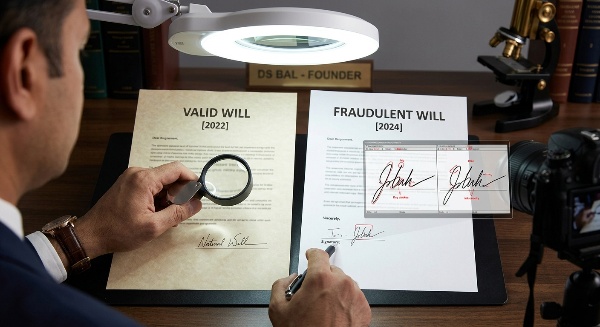
A dementia diagnosis does not automatically invalidate a Will in 2026; the legal focus is on “Testamentary Capacity” at the specific moment the Will was executed. Under the Banks v Goodfellow test, a testator must understand the nature of the Will, the extent of their estate, and the moral claims of potential beneficiaries. If a solicitor follows the “Golden Rule” by obtaining a medical professional’s opinion during drafting, the Will is significantly harder to challenge.

The Distinction Between Medical Diagnosis and Legal Capacity
In 2026, the UK courts maintain a sharp distinction between a clinical diagnosis of cognitive impairment and the legal threshold for “Testamentary Capacity.” A person may suffer from early-stage Alzheimer’s or vascular dementia and still possess the “lucid interval” necessary to execute a valid Will. The court does not ask if the testator was “ill,” but rather if their mind was “sound” enough to understand the specific legal act of disposing of their property. As long as the testator understands the consequences of the document they are signing, the Will remains valid regardless of a medical label.
The Banks v Goodfellow Test: Still the Gold Standard
Despite the passage of over 150 years, the 1870 case of Banks v Goodfellow remains the definitive test for capacity in 2026. This common law test requires the testator to meet four criteria: they must understand the nature of the act (making a Will), understand the extent of the property they are disposing of, comprehend the moral claims they ought to give effect to, and be free from any “disorder of the mind” that poisons their affections. Failure to meet even one of these criteria can lead to the entire Will being declared void by the High Court.
The 2026 Conflict: Common Law vs. The Mental Capacity Act 2005
A significant point of technical contention in 2026 is the interplay between the Banks v Goodfellow test and the Mental Capacity Act 2005 (MCA). While the MCA is used for “living” decisions (like Lasting Powers of Attorney), the courts have confirmed that the older common law test still governs the validity of a Will after death. However, modern judges frequently use the MCA as a “cross-check” or supportive framework. An “Elite” legal challenge often leverages the nuances of both tests to highlight inconsistencies in how the testator’s capacity was assessed at the time of signing.
The “Golden Rule” for Solicitors and Medical Reports
To prevent expensive litigation, 2026 probate practitioners strictly adhere to the “Golden Rule” established in Kenward v Adams. This rule suggests that when a testator is aged or has suffered a serious illness, the solicitor should seek a contemporaneous medical report from a GP or psychiatrist to confirm capacity. If Mr. Bal, as your solicitor, follows this rule, it creates a “presumption of validity” that is extremely difficult for disgruntled beneficiaries to overturn. Conversely, the absence of a medical report for a frail testator is often the first “red flag” we look for when initiating a contest.
The Power of “Lucid Intervals” in Probate Law
Many dementia patients experience “fluctuating capacity,” where they are confused in the evenings (often called “sundowning”) but remarkably clear in the mornings. In 2026, the law recognizes these “lucid intervals.” If it can be proven, via caregiver logs, medical notes, or witness testimony, that the Will was signed during a period of clarity, the Will is legally binding. This is why the testimony of the attesting witnesses is crucial; they provide the “on-the-ground” evidence of the testator’s state of mind at the exact moment the pen touched the paper.
Delusions and the “Poisoning of Affections”
Capacity isn’t just about memory; it’s about the absence of “insane delusions.” In 2026, we see cases where a testator is physically healthy but suffers from a fixed, false belief, for example, believing a child has been stealing from them when no such thing occurred. If this delusion “poisons” the testator’s mind and causes them to disinherit that child, the Will can be set aside for lack of capacity. This is technically distinct from “undue influence,” as the pressure comes from within the testator’s own disordered mind rather than an external person.
Burden of Proof: Who Must Prove Capacity?
The burden of proof in 2026 follows a specific “ping-pong” sequence. Initially, if a Will appears rational and was properly executed, capacity is presumed. However, if the person contesting the Will raises a “real doubt” (e.g., by producing a medical record of a stroke or a dementia diagnosis), the burden of proof shifts back to the executors of the Will. They must then prove, on the balance of probabilities, that the testator did indeed have the requisite capacity. This shift is a massive tactical advantage for those challenging a Will.
The “Parker v Felgate” Exception: Signing While Failing
A rare but vital rule in 2026 is the principle from Parker v Felgate. This allows a Will to be valid even if the testator lost capacity between giving instructions and signing the final document. If the testator had capacity when they gave the instructions to the solicitor, and at the time of signing they understood they were executing the Will they previously ordered, the court may uphold it. This rule protects those whose health declines rapidly during the drafting process, provided the solicitor acted with due diligence.
Digital Evidence: Smart Devices as 2026 Witnesses
In 2026, we increasingly use digital “behavioral markers” to prove or disprove capacity. We analyze a testator’s smart home interactions (like Alexa logs), their ability to navigate online banking, or the complexity of their text messages. If a testator was successfully managing an online investment portfolio or consistently using Uber at the time the Will was signed, this serves as strong “real-world” evidence of high-level cognitive function that can override a generic dementia diagnosis in the eyes of a judge.
The Costs of Challenging for Capacity
Challenging a Will for lack of capacity is an expensive undertaking in the UK. Unlike other forms of litigation, if there were “reasonable grounds” for the doubt, such as a confusing medical history, the court may order that the legal costs for both sides be paid out of the estate itself. However, if the challenge is deemed frivolous or purely “fishing for evidence,” the person bringing the claim could be hit with a massive personal costs order. Professional mediation is almost always recommended in 2026 before the case reaches the High Court.
The Role of the Larke v Nugus Statement
When capacity is questioned, the first step is always to request a Larke v Nugus statement from the solicitor who drafted the Will. This is a detailed account of the circumstances surrounding the Will’s execution. It reveals whether the solicitor saw the testator alone, how they checked for capacity, and what notes they took regarding the testator’s understanding of their assets. In 2026, a “thin” or poorly documented solicitor’s file is the most common reason Wills are successfully overturned for lack of capacity.
FAQs
Q1: My father had a stroke two days before signing his Will. Is it still valid?
A stroke does not automatically revoke capacity, but it raises a significant “doubt.” The court will look at whether the stroke affected his speech (aphasia) or his actual cognitive understanding. If he was able to communicate his wishes clearly, even through non-verbal means, and understood the “Banks v Goodfellow” criteria, the Will can be upheld.
Q2: Can a GP’s letter prove my mother had capacity?
A GP’s letter is strong evidence, but it is not infallible. In 2026, judges often prefer the testimony of a specialist geriatric psychiatrist over a general practitioner. If the GP’s assessment was brief (e.g., a “mini-mental state exam”), a legal specialist may still be able to challenge it by showing the GP didn’t specifically test for testamentary capacity.
Q3: What if the witnesses to the Will say the testator seemed “confused”?
Witness testimony is a “primary” source of evidence. If the two people who stood in the room during the signing testify that the testator didn’t know where they were or didn’t recognize the document, it is extremely difficult for the executors to prove capacity. This is why choosing independent, professional witnesses is so important in 2026.
Let’s Do This Together
Contesting a will could become an overwhelming experience if not accompanied by expert guidance and support. Our mission is to provide you with all the needed information, support, and authority to get through this journey, with only one goal in mind: Fairness.
To our team, this process is not about winning; it’s about claiming what was yours from the beginning.
Get your free, no-obligation case assessment. Call 08002980029 or visit contestawilltoday.com
Check our complete guide on how to contest a will in 2026, and arm yourself with the needed knowledge here!