No, a dementia diagnosis does not automatically invalidate a Will. Under the Banks v Goodfellow test, a Will is only void if the condition prevented the testator from understanding the act of making a Will, the extent of their assets, or their moral obligations at the specific moment of signing.
The Intersection of Medicine and Law
For “The Skeptic,” a diagnosis of Alzheimer’s or Vascular Dementia feels like an open-and-shut case. However, the law does not look for a medical label; it looks for functional capacity. In the UK, a person is presumed to have capacity until proven otherwise.
The “Lucid Interval” Defense
Courts acknowledge that dementia often involves fluctuating capacity. A testator may be confused on Tuesday but have a “lucid interval” on Wednesday when they sign their Will.
- The Proponent’s Goal: To prove the Will was signed during a period of clarity.
- The Skeptic’s Goal: To prove the “disorder of the mind” was so pervasive that a lucid interval was impossible.
The “Golden Rule” and the Solicitor’s Duty
One of the strongest weapons in a validity challenge is the Golden Rule. Established in the case of Kenward v Adams (1975), it dictates that when a solicitor is instructed by an elderly or seriously ill client, they should:
- Request a medical opinion on the testator’s capacity.
- Have a medical professional witness the signing of the Will.
If you find that your loved one signed a Will while suffering from dementia and the solicitor failed to follow this rule, the Will becomes highly vulnerable. The court will view the lack of a medical witness as a “suspicious circumstance.”
How Dementia Impacts the Three Limbs of Capacity
To set aside a Will, we must demonstrate that the dementia specifically impaired one of these three functions:
A. Understanding the Nature of the Act
Did the testator understand they were creating a legally binding document that would distribute their life’s work? Dementia can cause “executive dysfunction,” where a person can read the words but cannot comprehend the finality of the action.
B. Understanding the Extent of the Estate
Does the testator know what they own? If a parent with dementia signs a Will leaving a house they sold five years ago to a sibling, this is evidence that their “internal map” of their assets has been destroyed by the disease.
C. Comprehending Moral Claims
This is where “The Skeptic” usually finds the most evidence. Dementia can cause “personality changes” or “paranoia.” If a testator suddenly excludes a lifelong friend or a child because of an unfounded delusion that they were “stealing,” the Will fails this limb.
Gathering the Evidence: The Investigation
- MMSE and MoCA Scores: These are standard cognitive tests. A score below a certain threshold (often 24/30) can be a powerful indicator of incapacity.
- Larke v Nugus Statement: We must ask the solicitor: “Did you ask the testator why they were changing their Will?” If the solicitor has no notes, their “witnessing” of capacity is weak.
- Nursing Home Logs: Often, the most telling evidence isn’t from a doctor, but from a caregiver’s daily log: “Patient confused, did not recognize family today.”
For medical guidelines on dementia and mental capacity, check Alzheimer’s Society – Mental Capacity and Legal Documents
The Burden of Proof: Shifting the Scales
In a standard probate case, the person proving the Will (the executor) has the initial burden. However:
- If the Will looks rational and was signed correctly, the court presumes capacity.
- The Shift: Once “The Skeptic” provides medical evidence of dementia, the burden of proof shifts back to the executor. They must now prove, beyond a doubt, that the testator had capacity.
The Evidentiary Weight of “Day-to-Day” Observations
While clinical records provide the skeleton of a capacity challenge, the “muscle” of the case often comes from non-medical witnesses. As a Validity Specialist, we look for “lay evidence”, statements from neighbors, long-term friends, or even local shopkeepers who interacted with the deceased daily. If a neighbor can testify that the testator was wandering the street confused or failing to recognize their own front door in the weeks surrounding the Will’s execution, this provides a vivid, functional context that a sterile medical chart might miss. In court, this evidence is often used to “rebut” the solicitor’s claim that the testator appeared lucid during their 30-minute office appointment.
Retrospective Medical Assessments (The “Paper Trail” Diagnosis)
In many cases, a medical professional was never asked to assess the testator while they were alive. In these scenarios, “The Skeptic” must rely on a Retrospective Medical Report. This involves commissioning a consultant psychiatrist to review every scrap of available data, from GP records and prescription dosages to social service reports, to form an expert opinion on the likely state of the testator’s mind at the moment of execution. Because this expert never met the deceased, their report must be meticulously argued, focusing on how the recorded symptoms of dementia would have specifically interfered with the testator’s ability to “weigh and balance” the moral claims of their family members.
The “Sharp Focus” of Delirium vs. Permanent Decline
It is vital to distinguish between permanent cognitive impairment (like late-stage Alzheimer’s) and “Acute Delirium.” Often, a Will is signed in a hospital setting while the testator is battling a secondary infection, such as a UTI or pneumonia. Medical science confirms that these infections can cause sudden, temporary “brain failure” in the elderly, leading to hallucinations or total disorientation. If the Will was signed during such a medical crisis, the document is highly susceptible to being set aside. Even if the testator “seemed okay” to a layperson, the underlying medical data may prove they lacked the cognitive “bandwidth” to weigh complex moral claims at that specific moment.
Challenging the “Hand-Guided” Signature
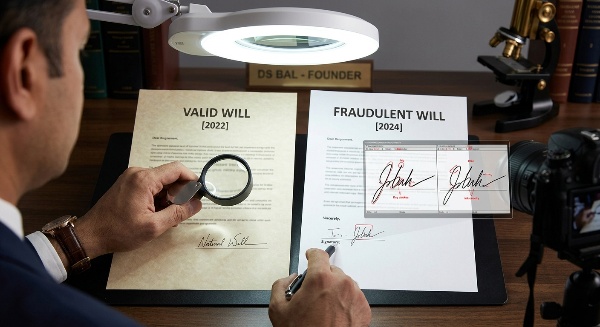
In many cases involving advanced dementia, the physical execution of the Will becomes a point of contention. “The Skeptic” should look closely at the signature itself. Was the testator’s hand “guided” by a beneficiary? While English law does allow for a “signed on behalf” signature under Section 9 of the Wills Act 1837, it requires very specific formalities. If a beneficiary physically moved the testator’s hand to sign the document because the testator was too confused or frail to do so voluntarily, this is not a valid execution. It suggests a lack of both capacity and independent “Knowledge and Approval,” rendering the document a legal nullity.
Read our guide to learn more: The Guided Hand: Contesting a Will Based on Forgery or Forced Signature
The Evidentiary Weight of “Day-to-Day” Lay Witness Testimony
While clinical records provide the skeleton of a capacity challenge, the “muscle” of the case often comes from non-medical witnesses. We look for “lay evidence”, statements from neighbors, long-term friends, or local shopkeepers who interacted with the deceased daily. If a neighbor can testify that the testator was wandering the street confused, failing to recognize their own front door, or dressing inappropriately for the weather in the weeks surrounding the Will’s execution, this provides a vivid, functional context. In court, this evidence is often used to rebut a solicitor’s claim that the testator appeared lucid during a brief 30-minute office appointment.
Stop the Wrongful Will
A dementia diagnosis is a red flag, not a finish line. To stop an invalid Will from being proved, you must act quickly to secure medical records and lodge a caveat.
For a complete look at the legal requirements for capacity, see our Complete Guide to Contesting a Will on Grounds of Lack of Capacity.
Download The Capacity Evidence Checklist to see if your evidence meets the legal threshold for a challenge.
FAQs
Q1: Can a Will be valid if the testator was in a coma shortly after signing?
Yes, it is possible. This is known as the rule in Parker v Felgate. If a testator had capacity at the time they gave instructions to a solicitor, and the Will was prepared according to those instructions, it may still be valid even if their capacity declined significantly by the time they actually signed the document, provided they understood they were signing a Will they previously authorized.
Q2: Does “forgetfulness” count as a lack of capacity?
No. The courts have long held that “a flickering mind” or a “failing memory” does not necessarily equal a lack of testamentary capacity. To win a challenge, you must prove that the forgetfulness specifically prevented them from understanding one of the Banks v Goodfellow limbs. Simple “senior moments” are not enough to set aside a legal document.
Q3: What happens if the Will is found invalid?
If the court rules that the testator lacked capacity, the Will is “set aside.” The law then looks for the previous valid Will. If no previous Will exists, the estate is distributed according to the Rules of Intestacy, which prioritize spouses and biological children. This is why “The Skeptic” must always check the contents of previous Wills before starting a challenge.
Act Now to Stop Probate
A dementia diagnosis is the starting point of an investigation, not the end. If you suspect a “FAKE” Will has been produced because a loved one was not of sound mind, you must lodge a caveat immediately.
Read our guide to learn more about caveats: The 2025 Caveat Surge: How to Stop an Unfair Will in its Tracks
Let’s Do This Together
Contesting a will could become an overwhelming experience if not accompanied by expert guidance and support. Our mission is to provide you with all the needed information, support, and authority to get through this journey, with only one goal in mind: Justice.
To our team, this process is not about winning; it’s about claiming what was yours from the beginning.
Get your free, no-obligation case assessment. Call 08002980029 or visit contestawilltoday.com