Can Substance Abuse Cause Lack of Mental Capacity? Substance abuse is a significant and growing factor in 2026 mental capacity assessments. Legally, the threshold for capacity is not just whether a person uses drugs or alcohol, but whether that use creates an “impairment of, or a disturbance in the functioning of, the mind or brain.” In the context of the Mental Capacity Act 2005, substance abuse can cause lack of capacity in two ways: through temporary impairment (intoxication at the specific time of decision-making) or permanent damage (irreversible cognitive decline from long-term misuse). In 2026, the courts have become increasingly sophisticated at “disentangling” the effects of addiction from underlying mental health conditions.
Read our complete guide on contesting a will for lack of capacity.
Temporary Impairment: The “Snapshot” of Intoxication
The law recognizes that mental capacity is decision-specific and time-specific. Active intoxication can temporarily deprive an individual of the ability to understand, retain, or weigh up information. If a person is under the influence of alcohol or narcotics at the exact moment they are asked to make a legal decision—such as signing a contract or changing a Will—they may be found to lack capacity for that specific “snapshot” in time.
In 2026, the focus has shifted toward the “weighing up” stage of the capacity test. An intoxicated person might understand what they are doing (understanding) and remember it (retention), but the substance may make them unable to appreciate the risks or consequences of the decision (weighing up).
- Key Criterion: Does the substance prevent the person from communicating a capacitous choice?
- The “Fluctuating” Nature: Capacity can return once the substance leaves the system, meaning a person could lack capacity at 2:00 PM but regain it by 9:00 AM the next day.
Permanent Damage: When Misuse Becomes a Disorder
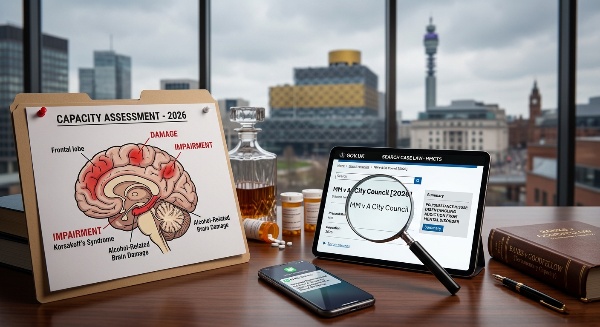
Long-term substance misuse often crosses the line from a behavioral habit to a clinical brain injury. In 2026, we see a rise in cases involving Alcohol-Related Brain Damage (ARBD), which includes conditions like Korsakoff’s Syndrome or alcohol-related dementia. These are not temporary “clouds” on the mind; they are permanent impairments of the brain’s physical structure.
Korsakoff’s Syndrome, for example, creates severe gaps in short-term memory and leads to “confabulation”—where the individual unintentionally invents stories to fill memory gaps. In a legal context, a person suffering from this cannot “retain” the necessary information long enough to make a valid decision, even if they appear sober at the time of the meeting.
The 2026 Context: MM v A City Council
The landscape of capacity law was significantly refined by the case of MM v A City Council [2026]. This case highlights the challenges of “polysubstance misuse”—where an individual uses multiple types of drugs alongside alcohol. The court ruled that practitioners must perform a delicate “disentangling” act.
The judge noted that the court must distinguish between:
- The effects of the addiction (the craving and compulsion).
- Any underlying mental disorder (such as learning disabilities or personality disorders).
- The temporary effects of the drugs themselves.
Substance Abuse and Contesting a Will
When it comes to mental Capacity (the legal ability to make a Will), substance abuse is a frequent ground for challenge. To make a valid Will, the testator must meet the Banks v Goodfellow (1870) test, which requires them to understand the nature of the act and the extent of their property.
- The “Lucid Interval” Defense: If a Will was made by a known alcoholic, the court will look for a “lucid interval”—a period where they were sober and clear-headed. If the Will was signed during a binge, it is highly likely to be voided.
- The “Vulnerability” Angle: Substance abuse often makes a person highly dependent on others for their supply or care. This creates a perfect storm for Undue Influence. If a “new friend” provided drugs or alcohol to the testator in exchange for being written into the Will, the court may strike the Will down for lack of “knowledge and approval.”
- 2026 Evidence: We now use toxicology reports, GP records of “dependency syndrome,” and even smart-home data (showing frequency of alcohol deliveries) to prove that a testator was not in a fit state to sign legal documents.
FAQs
1. If someone is an alcoholic, does that mean their Will is automatically invalid?
No. Being an alcoholic is a medical status, not a legal one. The Will is only invalid if the alcohol was actively affecting their mind at the time the Will was signed, or if long-term drinking had caused permanent cognitive decline (like dementia).
2. How do we prove someone was “too high” to sign a document?
In 2026, we look at “contemporaneous evidence.” This includes witness testimony (did they smell of alcohol? were they slurring?), text messages sent around that time, and medical records. If a solicitor didn’t follow the “Golden Rule” and check for sobriety, it becomes much easier to challenge.
3. What did the MM v A City Council [2026] case change for families?
It forced local authorities and legal professionals to look deeper. They can no longer just say “they’re a drug user, so they can’t decide.” They must prove that the drug use has caused a specific functional inability to make a specific decision, often requiring a forensic psychiatric report.
Let’s Do This Together
Contesting a will could become an overwhelming experience if not accompanied by expert guidance and support. Our mission is to provide you with all the needed information, support, and authority to get through this journey, with only one goal in mind: Fairness.
To our team, this process is not about winning; it’s about claiming what was yours from the beginning.
Get your free, no-obligation case assessment. Call 08002980029 or visit contestawilltoday.com
Meet Our Founder
With over 30 years of experience across civil litigation and dispute resolution, DS Bal brings a deep, broad understanding of the legal process to every case. His background spans complex disputes involving individuals, families, and estates. LinkedIn