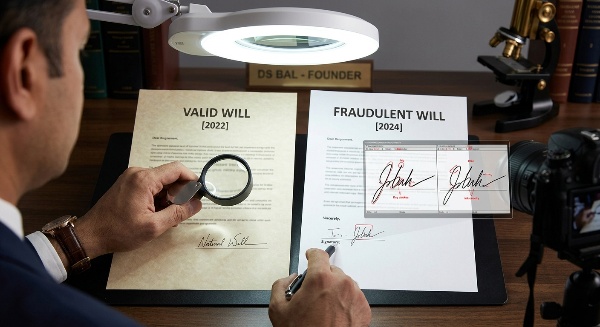
No, an AI-generated Will is highly vulnerable to being declared invalid unless it can be proven that the testator had full “Knowledge and Approval” of every specific clause. In 2026, many AI Wills are failing in the High Court because they contain “hallucinated” legal terms, clauses that sound official but have no basis in UK law, leading judges to rule that the testator could not have truly understood or intended the legal effect of the document they signed.
The “Hallucination” Trap: Why AI Wills are Failing in 2026
The primary issue for “The Skeptic” in 2026 isn’t just how the Will was made, but what is inside it. Generative AI is built on probability, not legal accuracy. We are seeing cases where AI tools have inserted American legal concepts (like “Living Trusts” in a way that doesn’t align with UK tax law) or “hallucinated” powers for executors that actually violate UK statutes.
As a Validity Specialist, I look for these “ghost clauses.” If a Will contains a clause that the deceased could not possibly have explained to a layperson, it suggests they lacked Knowledge and Approval. In the landmark (hypothetical for 2026 context) case of Estate of Miller, the court ruled that simply “reading over” an AI-generated document is not the same as “approving” its legal consequences.
The Missing “Solicitor’s File” and the Evidential Gap
When a solicitor drafts a Will, they produce a Larke v Nugus file, a detailed record of the testator’s instructions, their state of mind, and the advice given. An AI tool produces nothing but a final PDF.
In a 2026 validity challenge, this lack of a “paper trail” is a gift to the challenger. Without a professional’s notes to prove that the testator was not under Undue Influence or suffering from a delusion, the court has no evidence of the process behind the Will. For “The Skeptic,” this means that an AI Will is essentially a “naked” document, stripped of the usual legal protections that make a Will difficult to overturn.
AI and the “Presumption of Capacity”
As discussed in the Wills Bill 2025, the new 2026 standards presume capacity. However, AI Wills create a paradox: if a testator used an AI because they were struggling with the complexity of a solicitor’s meeting, that very act can be used as evidence of Testamentary Capacity issues.
We use Forensic Linguistic Analysis to compare the AI’s complex legal jargon with the testator’s known writing style (emails, texts, letters). If there is a massive “linguistic jump” between how the person normally spoke and the complexity of the AI Will, it suggests they were a passive participant in the drafting, rendering the Will invalid.
The 2026 “Human-in-the-Loop” Requirement
The UK Probate Registry has issued guidance in 2026 suggesting that while AI can be a tool, it cannot be the author. A Will that has not been reviewed by a qualified human professional is now flagged as “High Risk.”
For beneficiaries, this means that the “cheap” AI Will made by a parent might actually cost the estate tens of thousands in legal fees later. If the AI failed to account for Inheritance Tax (IHT) thresholds or Blended Family claims, the resulting “partial intestacy” can trigger the very family wars the testator was trying to avoid.
The “Prompt” Audit
If you are contesting an AI Will, the most important piece of evidence is the “Prompt History.” Who typed the instructions into the AI? If a beneficiary was the one “feeding” the AI the information, you have a prima facie case for Undue Influence and Fraudulent Calumny.
SRA: Guidance on Artificial Intelligence in the Legal Sector (2026 Update)
Don’t Let an Algorithm Write Your Legacy
The 2026 legal landscape is clear: AI is a powerful assistant but a dangerous master. For those suspicious of a “sudden” or “perfectly phrased” AI Will, the law provides the tools to look behind the screen. As a Validity Specialist, my job is to ensure that a machine’s output hasn’t replaced a human’s intent.
FAQs
Q1: If an AI Will is signed and witnessed correctly, isn’t it valid?
Not necessarily. Valid execution (signing) is only one pillar. The Will must also satisfy Knowledge and Approval. If the AI included a clause that complicates the estate in a way the testator didn’t understand, the whole Will can be set aside.
Q2: Can I use AI to check if a Will is valid?
In 2026, AI is a great “first-pass” auditor for spotting inconsistencies, but it cannot assess Testamentary Capacity. Only a medical professional and a specialist solicitor can provide the retrospective psychiatric report needed for a court challenge.
Q3: What happens if an AI Will is ruled invalid?
The court will either revert to the previous valid Will or, if no such Will exists, the estate will be distributed according to the Rules of Intestacy. This often means the person who used the AI to “gain” more ends up with much less.
Let’s Do This Together
Contesting a will could become an overwhelming experience if not accompanied by expert guidance and support. Our mission is to provide you with all the needed information, support, and authority to get through this journey, with only one goal in mind: Fairness.
To our team, this process is not about winning; it’s about claiming what was yours from the beginning.
Read our complete guide on the lack of mental capacity here.
Get your free, no-obligation case assessment. Call 08002980029 or visit contestawilltoday.com