Can Cousins Inherit Under Intestacy UK? Under UK intestacy rules, cousins can inherit only if the deceased was not survived by a spouse, children, parents, siblings, or grandparents. As “descendants of aunts and uncles,” they occupy the final tier of the inheritance hierarchy. If no eligible cousins are found, the estate passes to the Crown as Bona Vacantia.
When a person dies without a Will in England and Wales, their estate is distributed according to the Administration of Estates Act 1925. This legal framework, updated by the Inheritance and Trustees’ Powers Act 2014, provides a rigid order of priority. Cousins often find themselves in a difficult position: they are family, but in the eyes of the law, they are last in line.
Read our complete guide on contesting a will for lack of capacity.
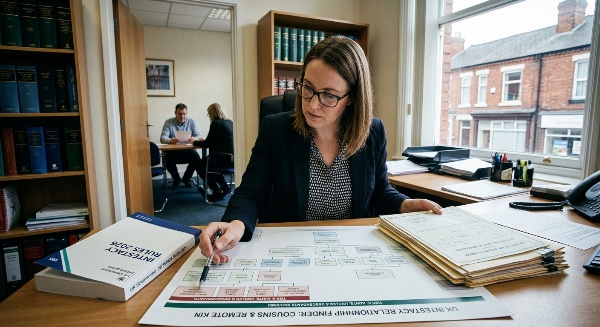
The Hierarchy of Inheritance: Where Cousins Sit
The intestacy rules operate like a checklist. You only move to the next category if no one exists in the previous one. Cousins are located in the sixth and final category of blood relatives. Before a cousin can inherit, the law must confirm there is no surviving:
- Spouse or civil partner
- Children, grandchildren, or great-grandchildren
- Parents
- Siblings of the “whole blood” (or their children)
- Siblings of the “half blood” (or their children)
- Grandparents
- Aunts and uncles (or their descendants—which is where cousins enter).
The “Per Stirpes” Rule for First Cousins
If you qualify to inherit, you do so under the “per stirpes” (by the branch) rule. This means if an aunt or uncle would have inherited but is deceased, their share is divided equally among their children—the cousins. For example, if an estate was meant to be split between two uncles, and one has died leaving three children, those three cousins will share that uncle’s 50% portion equally.
First Cousins vs. Second Cousins: Who is Eligible?
Under the Administration of Estates Act, only “first cousins” (children of aunts and uncles) are automatically recognized. However, if a first cousin died before the deceased, their own children (first cousins once removed) can inherit that parent’s share. “Second cousins” (who share great-grandparents) generally do not inherit under UK intestacy rules unless the estate reaches an even more remote stage of genealogical tracing.
The Distinction Between Whole-Blood and Half-Blood
The law prioritizes “whole-blood” aunts and uncles (those who shared both parents with the deceased’s parent). Only if there are no whole-blood relatives do the “half-blood” branches become eligible. This means a half-blood cousin will only inherit if there are absolutely no whole-blood aunts, uncles, or cousins surviving.
Can Step-Cousins Inherit?
Unless there is a legal adoption, step-cousins have no rights under UK intestacy rules. The law strictly follows biological or legally adopted bloodlines. Even if a step-cousin lived with the deceased for decades, they are legally excluded without a Will.
The High Burden of Proof for Cousins
When a distant relative dies, the burden of proof is on the claimant. In 2026, probate registries require certified copies of birth, marriage, and death certificates for every link in the chain—from the deceased back to the common grandparents, and then down to the claimant.
Forensic Genealogy and “Bona Vacantia”
If no qualifying relatives are found, the estate is declared Bona Vacantia (vacant goods) and passes to the Crown. In many cases, professional “heir hunters” are employed to find cousins before the 12-year (or 30-year) claim limit expires.
The Risk of Partial Intestacy
Sometimes a Will exists but doesn’t cover the entire estate—perhaps because a beneficiary died or a clause was poorly drafted. In these cases of “partial intestacy,” the remaining assets are distributed according to the hierarchy, meaning cousins could potentially inherit even if a Will was present for other assets.
Estrangement Does Not Affect Rights
Under the law, it does not matter if a cousin was estranged or had never met the deceased. If they are the closest living blood relative according to the hierarchy, they are the legal heir. This often leads to probate disputes when closer “friends” or step-family members are excluded.
Challenging an Unfair Distribution
If a cousin feels they were wrongly excluded—perhaps because a marriage was invalid or a closer relative was not actually a blood relation—they may have grounds for contesting a trust or the distribution of the estate.
The 2026 Advice: Why a Will is Critical
Relying on the “cousin tier” of intestacy is risky. The administrative costs of proving such a distant relationship often deplete the estate. If you wish for a cousin to inherit, or if you are a cousin hoping to protect a vulnerable relative’s estate, a professionally drafted Will is the only way to bypass the rigid, and often cold, hierarchy of the law.
FAQs
1. Do first cousins once removed inherit?
Yes, but only if their parent (the first cousin) is deceased. They “step into the shoes” of their parent to claim the share that would have gone to the first cousin.
2. What happens if some cousins are “whole-blood” and others are “half-blood”?
The whole-blood branch takes total priority. If there is even one living whole-blood cousin (or their descendant), the half-blood cousins will receive nothing from the estate.
3. How do I start a claim as a cousin?
You should first search the Bona Vacantia list to see if the estate has been advertised. Then, you must instruct a solicitor to help you compile a verified family tree and apply for Letters of Administration.
Let’s Do This Together
Contesting a will could become an overwhelming experience if not accompanied by expert guidance and support. Our mission is to provide you with all the needed information, support, and authority to get through this journey, with only one goal in mind: Fairness.
To our team, this process is not about winning; it’s about claiming what was yours from the beginning.
Get your free, no-obligation case assessment. Call 08002980029 or visit contestawilltoday.com
Learn more about our no win, no fee service.
Meet Our Founder
With over 30 years of experience across civil litigation and dispute resolution, DS Bal brings a deep, broad understanding of the legal process to every case. His background spans complex disputes involving individuals, families, and estates. LinkedIn