The Golden Rule in 2026 remains the judicial benchmark for determining if a solicitor took adequate steps to verify a testator’s capacity. If a legal professional failed to secure a medical report for an elderly or ill client, it creates a “rebuttable presumption” of professional negligence. This failure is often the strongest weapon in a Will contest, as it shifts the evidentiary burden and can make the solicitor’s firm liable for the costs of the dispute.
Read our complete guide on contesting a will for lack of capacity.
Defining the Golden Rule in a Modern Legal Context
The “Golden Rule” is not a statutory law, but a long-standing judicial guideline reaffirmed in 2026 as a critical safeguard against inheritance disputes. It dictates that when a solicitor is instructed to draft a Will for a testator who is elderly or has a history of serious illness, they should ideally have the execution witnessed or approved by a medical practitioner.
In the high-stakes environment of 2026 probate, this rule serves as the ultimate “insurance policy” for a Will’s validity. If a solicitor bypasses this step, they leave the estate vulnerable to claims that the testator lacked the mental capacity to understand the consequences of their decisions.
Why Professional Negligence is Your “Silver Bullet”
When contesting a Will, proving “Incapacity” can be medically difficult after the testator has passed. However, proving Professional Negligence against the drafting solicitor is often a more direct path to victory. If the solicitor failed to follow the SRA (Solicitors Regulation Authority) 2026 standards for capacity checking, their “Attendance Notes” become the primary evidence against the Will. A negligent solicitor who didn’t ask probing questions or failed to identify “red flags” essentially hands the challenger a roadmap to voiding the document.
The Shift in the Burden of Proof
In 2026, the High Court is increasingly strict regarding the “Burden of Proof.” Ordinarily, the person contesting the Will must prove the testator was unfit. However, if it is proven that the solicitor failed the “Golden Rule,” the burden often shifts back to the executors to prove the testator was fit. This technical shift is a massive strategic advantage for our clients at Contest A Will Today, as it forces the opposing side to produce medical evidence that may not exist.
Attendance Notes: The 2026 “X-Ray” of a Claim
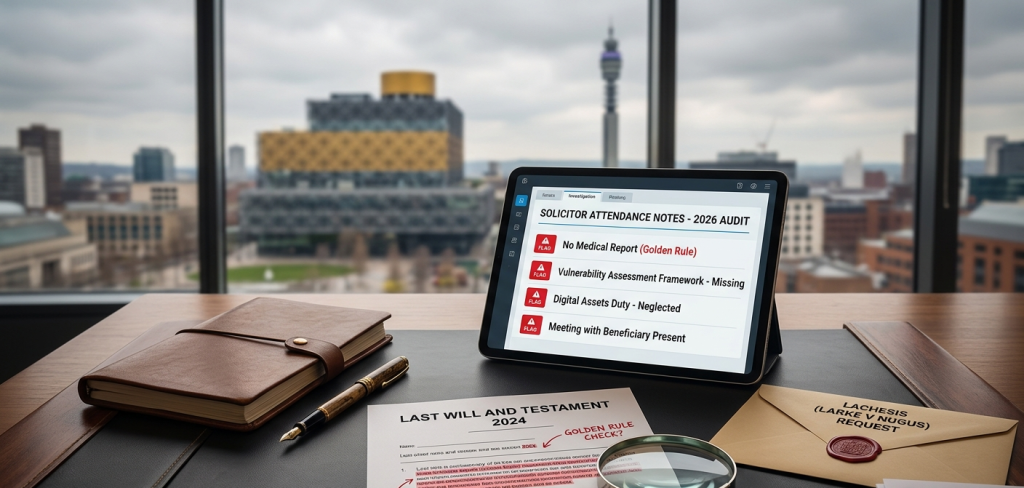
Under the Lachesis (Larke v Nugus) request protocol, we can demand the drafting solicitor’s entire file. In 2026, we look for “Thin Notes.” If a solicitor simply wrote “Testator seemed fine,” without documenting a deep-dive into the assets or moral claims, they have likely been negligent.
- Red Flag: No mention of why a child was disinherited.
- Red Flag: No record of the testator’s recent medical history or medications.
- Red Flag: Meeting the testator in the presence of a beneficiary.
The “Medical Expert” vs. The “High Street Solicitor”
A common 2026 battleground is the “Expertise Gap.” Many solicitors claim they can “judge capacity” themselves, but the High Court disagrees. Following the Re: Thompson [2025] ruling, the courts have stated that a solicitor’s “gut feeling” is no substitute for a formal MoCA (Montreal Cognitive Assessment) or a psychiatric report. If a solicitor played doctor and got it wrong, the Will is almost certainly heading for a successful challenge.
Recovering Costs Through Negligence Claims
One of the most powerful aspects of using negligence as a weapon is the “Cost Recovery” factor. If a Will is voided because a solicitor was negligent, the claimant can often sue the solicitor’s firm for the legal costs incurred during the dispute. This significantly lowers the financial risk for our clients, as the solicitor’s Professional Indemnity Insurance becomes the “pot” that covers the litigation fees.
The 2026 SRA Standards and “Vulnerable Clients”
The SRA updated its “Code of Conduct” in late 2025 to include stricter definitions of “Vulnerability.” Solicitors are now required to use a Vulnerability Assessment Framework before taking instructions.
- Mandatory Checklist: Identifying signs of “Sundowning.”
- Mandatory Checklist: Checking for digital asset competency.
- Mandatory Checklist: Verifying the testator’s independence from their “new friends.” Failure to use this framework is a direct admission of professional negligence in 2026.
“Lachesis” Requests: Forcing the Solicitor’s Hand
In 2026, the Lachesis Protocol (formerly Larke v Nugus) is the first step in any negligence-based Will contest. It forces the solicitor to answer a series of pointed questions about how they verified the testator’s mind. If the solicitor is slow to respond or provides vague answers, the court can draw an “adverse inference”—essentially assuming they have something to hide.
Negligence in Digital Asset Management
With the Property (Digital Assets etc) Act 2025, solicitors now have a duty to ensure the testator understands their digital estate. If a solicitor drafts a Will but fails to ask about crypto-keys, NFTs, or digital intellectual property, they may be negligent. A testator who “forgot” they had £2M in Bitcoin likely didn’t have the “extent of their property” in mind, and a solicitor who didn’t check this failed the Banks v Goodfellow test.
The “Deathbed Will” and the Heightened Duty
A “Deathbed Will” is the ultimate test of the Golden Rule. In 2026, if a solicitor drafts a Will in a hospital or hospice without a doctor’s sign-off, the High Court views it with extreme suspicion. The “Heightened Duty of Care” means the solicitor must take double the usual precautions. If they didn’t, the Will is highly susceptible to a “Lack of Knowledge and Approval” claim.
Strategizing Your Claim with DS Bal
At Contest A Will Today, we don’t just sue the estate; we look at the conduct of the professionals involved. By identifying professional negligence early, we can often force a settlement before a case even reaches the High Court. If a solicitor knows their file is weak and their insurance is at risk, they are much more likely to advise the executors to settle the claim in your favor.
Case Study: The Estate of Arthur Penhaligon [2026]
The Background:
In late 2025, Arthur, a 92-year-old retired engineer in Birmingham with a diagnosed history of “mild cognitive impairment,” instructed a high-street solicitor to draft a new Will. This new document completely disinherited his two children in favor of a neighbor who had recently begun managing his household finances.
The Negligence:
The drafting solicitor met Arthur only once, via a 15-minute video call. Despite Arthur’s age and the radical change in his instructions, the solicitor:
- Failed the Golden Rule: Did not request a medical capacity report or contact Arthur’s GP.
- Ignored the SRA 2026 Guidelines: Did not conduct a “Digital Competency” check, despite Arthur’s estate containing significant cryptocurrency assets.
- Weak Attendance Notes: The file merely stated, “Client appeared alert and decisive,” with no record of why the children were being excluded.
The Strategy (Contest A Will Today):
When Arthur passed away in early 2026, the children contacted DS Bal. Instead of a long, drawn-out battle over Arthur’s medical state, we launched a two-pronged attack:
- Lachesis Request: We forced the disclosure of the solicitor’s file, which revealed the “Thin Notes” and the lack of a medical assessment.
- Negligence Pressure: We informed the solicitor’s firm that if the Will were found invalid, we would hold them personally liable for the estate’s legal costs due to their failure to follow the Golden Rule.
The Result:
Faced with the risk of a professional negligence claim and an indefensible file, the solicitor’s professional indemnity insurers advised the executors to settle. The children recovered 85% of the estate value through mediation, avoiding a full High Court trial.
Let’s Do This Together
Contesting a will could become an overwhelming experience if not accompanied by expert guidance and support. Our mission is to provide you with all the needed information, support, and authority to get through this journey, with only one goal in mind: Fairness.
To our team, this process is not about winning; it’s about claiming what was yours from the beginning.
Get your free, no-obligation case assessment. Call 08002980029 or visit contestawilltoday.com
FAQs
1. Does every elderly testator need a doctor’s note in 2026?
While not a “law,” it is a Rule of Good Practice. Following Jenkins v Evans [2025], the High Court ruled that while a lack of a medical report isn’t “fatal” to a Will, it makes the solicitor’s attendance notes the only thing standing between a valid Will and a successful challenge. In 2026, if there is “any doubt” about capacity, a report is mandatory for a solicitor to be considered “competent.”
2. Can I sue the solicitor if the Will is valid but I lost money due to their delay?
Yes. Under the principle of White v Jones, solicitors owe a duty of care to intended beneficiaries. If a solicitor delays drafting a Will (measured in days or weeks for elderly clients in 2026) and the testator dies before signing, the lost beneficiaries can sue the solicitor for the full value of the inheritance they would have received.
3. What is the “long-stop” for a negligence claim in 2026?
You generally have six years from the date of the negligent act (the Will drafting) or three years from the date you discovered the mistake. However, there is an absolute “long-stop” of 15 years. Because 2026 is seeing higher scrutiny of Wills made during the 2020-2022 pandemic, many “hidden” negligence cases are only now coming to light.
Meet Our Founder
With over 30 years of experience across civil litigation and dispute resolution, DS Bal brings a deep, broad understanding of the legal process to every case. His background spans complex disputes involving individuals, families, and estates. LinkedIn