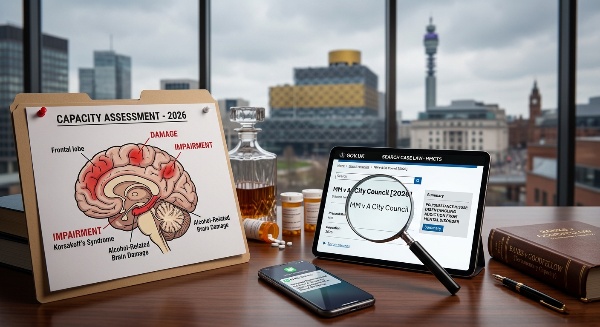
Lack of Mental Capacity is a powerful legal ground for contesting a Will in the UK, asserting that the deceased (the testator) lacked the necessary cognitive ability to understand the effects of their actions when the Will was signed. The legal standard applied is the Banks v. Goodfellow test, which requires the testator to comprehend the nature and effect of making a Will, the extent of their property, and the moral claims they ought to consider. Evidence for such a claim is primarily based on comprehensive medical records and testimony from the drafting solicitor and witnesses, often necessitating expert legal and medical evaluation.

What Does “Mental Capacity” Mean in Law?
In UK law, the ability to make a valid Will is governed by a long-established common law test, distinct from medical definitions of capacity. This test stems from the landmark 1870 case, Banks v. Goodfellow.
The Banks v. Goodfellow Test
To have the requisite mental capacity (often called Testamentary Capacity) when making or altering a Will, the person (the testator) must satisfy three key requirements:
- Understand the Nature of Making a Will: The testator must comprehend that they are signing a legal document that dictates how their property will be distributed upon their death.
- Know the Extent of Their Property: They must have a general awareness of the assets (money, property, investments) they own and are disposing of.
- Appreciate the Moral Claims: Crucially, the testator must be able to recall and understand the persons who might naturally expect to benefit from the Will (e.g., family members, close dependents) and be capable of making a rational decision as to whether to include them.
If, due to illness or cognitive decline, the testator fails any of these three requirements, the Will can be successfully challenged as invalid.
When Does Lack of Mental Capacity Become a Valid Legal Challenge?
The legal challenge is not simply based on the presence of a cognitive illness; it focuses on the testator’s state of mind at the specific time the Will was executed.
Cognitive Illnesses Are Red Flags, Not Proof
Conditions like dementia, Alzheimer’s disease, advanced age, or the effects of medication are common factors that give rise to claims of lack of capacity. However, the mere diagnosis of dementia, for example, is not proof of incapacity. A person might experience “lucid intervals” where their cognitive function returns temporarily. If the Will was made during such a lucid interval, it may still be valid.
This is why timing is so critical. Your legal challenge must establish that the incapacity existed at the moment the Will was signed. If the Will was drafted over several weeks or months, the testator should have had capacity when they gave instructions and when they executed the final document.
The Problem with the “Golden Rule”
Solicitors preparing a Will for an elderly or seriously ill client are strongly advised to follow the “Golden Rule.” This rule dictates that a medical practitioner should examine the testator immediately before the Will is signed and provide a written opinion confirming their testamentary capacity.
When a Will is challenged, if the drafting solicitor failed to follow the Golden Rule, it creates a significant red flag and can increase the weight placed on the challenging party’s evidence.
Building Your Case: The Power of Evidence
A successful claim of lack of capacity requires a meticulous and objective approach. Because the testator is unable to speak for themselves, your case relies on external, contemporary evidence.
1.Medical Evidence is Paramount
The most powerful evidence comes from the testator’s medical history. Your legal team will seek comprehensive access to:
- GP and Hospital Notes: Showing the progression of cognitive decline, prescribed medications, and physician assessments of the testator’s mental state around the date the Will was signed.
- Mental Capacity Assessments: Any formal assessments conducted by psychiatrists or specialist medical
2. The Solicitor’s File and Witness Statements
The file kept by the drafting solicitor is crucial. It should contain records of their meetings with the testator, including their assessment of mental capacity and any notes regarding the testator’s knowledge of their property and family claims. Statements from witnesses who were present at the signing are also required.
3. Lay Evidence
Statements from family members, friends, or care providers who had regular contact with the deceased can provide powerful, anecdotal evidence about their daily confusion, memory loss, and difficulty understanding simple financial matters during the relevant period.
The necessity of gathering this complex evidence often brings legal and medical considerations together. The process of obtaining medical records and formal opinions on testamentary capacity is subject to stringent rules within the UK legal system, ensuring both accuracy and patient privacy. You can find detailed, official guidance on the legal procedures for requesting and handling such sensitive information from The Law Society’s practice notes on testamentary capacity.
The Emotional Toll: Seeking Justice, Not Revenge
Contesting a Will based on mental capacity can be emotionally draining. You are essentially bringing evidence that your loved one was not themselves, and this can feel like disloyalty.
We want to assure you that your quest is not an act of revenge, but an act of deep respect. You are fighting to ensure that your loved one’s final, coherent wishes, the wishes they held before their mental capacity was compromised, are upheld. You are seeking to correct a profound wrong that was inflicted upon them while they were vulnerable. Read our guide for more information on how to cope with the emotional stress of contesting a will: The Emotional Toll of Contesting a Will and How to Cope: Legal Grounds and When Not to Contest a Will
Our compassionate expert team works diligently to separate the emotional pain from the legal facts. We provide the clear, objective, and authoritative guidance needed to navigate this deeply sensitive area, ensuring you are empowered to challenge the Will effectively and secure a just outcome.
Empowering Your Right to Fairness
Lack of Mental Capacity is a powerful, well-defined legal ground for contesting a Will, but it demands speed and specialist expertise. If you have concerns about a vulnerable loved one’s final Will, do not delay. The passage of time makes gathering the necessary medical and testimonial evidence significantly more difficult.
Empower yourself with clear, objective advice.
Get your free, no-obligation case assessment. Call 08002980029 or visit contestawilltoday.com
FAQs1. Who holds the burden of proof in a Will challenge based on Lack of Mental Capacity?
Initially, the law presumes an adult had the capacity to make a Will, meaning the challenger (you) must present enough compelling evidence (like medical records or witness statements) to raise a “real doubt” about the deceased’s capacity. If you succeed in raising that real doubt, the burden of proof then shifts to the party defending the Will (the propounder, usually the Executor) to definitively prove, on the balance of probabilities, that the deceased did have the required capacity when the Will was signed.
2. Can the costs of obtaining the deceased’s medical records and expert opinions be recovered?
The cost of obtaining a deceased person’s GP records is typically free under the Access to Health Records Act 1990. However, the costs associated with getting expert medical opinions from specialists (like a geriatric psychiatrist) or obtaining extensive hospital records can be significant. If your Will challenge is successful, the court often orders the losing party (the estate, or the defender of the Will) to pay some or all of your legal costs, which would include these necessary investigation expenses.
3. If a person lacked mental capacity, why was a Statutory Will not made on their behalf?
A Statutory Will is a special Will drafted by the Court of Protection for an individual who currently lacks the mental capacity to make one themselves. It is often required if the person has never made a Will, or if their existing Will is severely outdated. If the deceased lacked capacity but did not have a Statutory Will, it means no one made a successful application to the Court of Protection before their death. In such a scenario, if the contested Will is invalidated, the estate would be distributed according to either their previous valid Will or the Rules of Intestacy (if no previous valid Will exists).